 English
 русский
 Español
 中文简体
中文简体If you need any help, please feel free to contact us
In modern manufacturing, producing consistent, durable, and precise metal parts is essential. Hardw...
READ MORE
Free Quote

A connector head is a critical component in electrical and electronic systems, serving as the interface between two or more electrical circuits. It connects cables, wires, or devices, ensuring the secure transmission of power or data while maintaining high levels of reliability and efficiency. Connector heads are widely used in various industries, including automotive, industrial automation, telecommunications, and consumer electronics, among others.
These components are designed to ensure the proper alignment and contact between different electrical connections, preventing short circuits, signal interference, or power loss. Connector heads come in various shapes, sizes, and configurations to meet the diverse needs of different applications. They may be designed for high voltage, high-speed data transmission, or low-power connections, with materials and construction methods chosen to optimize their performance in specific environments.
Application:
Connector heads are versatile and play a key role in several applications across a wide range of industries. Some of the most notable applications include:
Automotive Industry: In vehicles, connector heads are used in wiring harnesses to establish electrical connections between various components, including sensors, lights, engines, and control units. Automotive connector heads are designed to withstand harsh conditions such as high temperatures, vibrations, and exposure to chemicals or moisture, ensuring safe and reliable electrical connections throughout the vehicle.
Industrial Automation: In industrial settings, connector heads are essential for connecting equipment like robots, machines, sensors, and controllers within automated systems. These connectors ensure reliable signal and power transmission between devices, facilitating smooth and efficient operations. Industrial connectors must meet rigorous standards for durability, safety, and performance to support demanding environments.
Telecommunications: In the telecommunications industry, connector heads are crucial for establishing high-speed data connections in networks. Whether in fiber optic systems, copper-based wiring, or wireless communication systems, connector heads provide secure, interference-free connections that enable fast and reliable data transmission across vast distances. High-quality connectors ensure minimal signal loss and optimal performance.
Consumer Electronics: Connector heads are widely used in consumer electronics, such as smartphones, laptops, and home appliances, to connect various internal components like screens, batteries, or charging ports. These connectors must be compact, easy to install, and capable of handling the power or data requirements of the device. Precision and durability are essential to ensure that consumer devices remain functional and safe.
Advantages:
Connector heads offer several key benefits that make them indispensable in modern electrical and electronic systems. Some of the key advantages include:
Reliability and Durability: One of the most significant advantages of connector heads is their ability to provide reliable and durable connections. These components are engineered to withstand various environmental factors such as temperature fluctuations, humidity, vibration, and mechanical stress. High-quality materials, such as gold-plated contacts or corrosion-resistant alloys, are often used to ensure longevity and optimal performance even under challenging conditions.
Versatility and Flexibility: Connector heads come in a wide variety of shapes, sizes, and configurations to meet the specific needs of different applications. Whether the requirement is for high-speed data transmission, low-power connections, or robust power links, connector heads can be customized to suit these needs. This flexibility makes them suitable for industries as diverse as automotive, telecommunications, medical, and industrial automation.
Ease of Installation and Maintenance: Connector heads are designed for ease of installation, reducing downtime and simplifying the overall assembly process. Many connector heads feature "plug-and-play" designs, which allow for quick and easy connections without the need for specialized tools. This makes them ideal for use in mass production settings, where efficiency is key. Furthermore, their modular nature allows for easier repairs or replacements, minimizing system downtime in case of a failure.
information to be updated
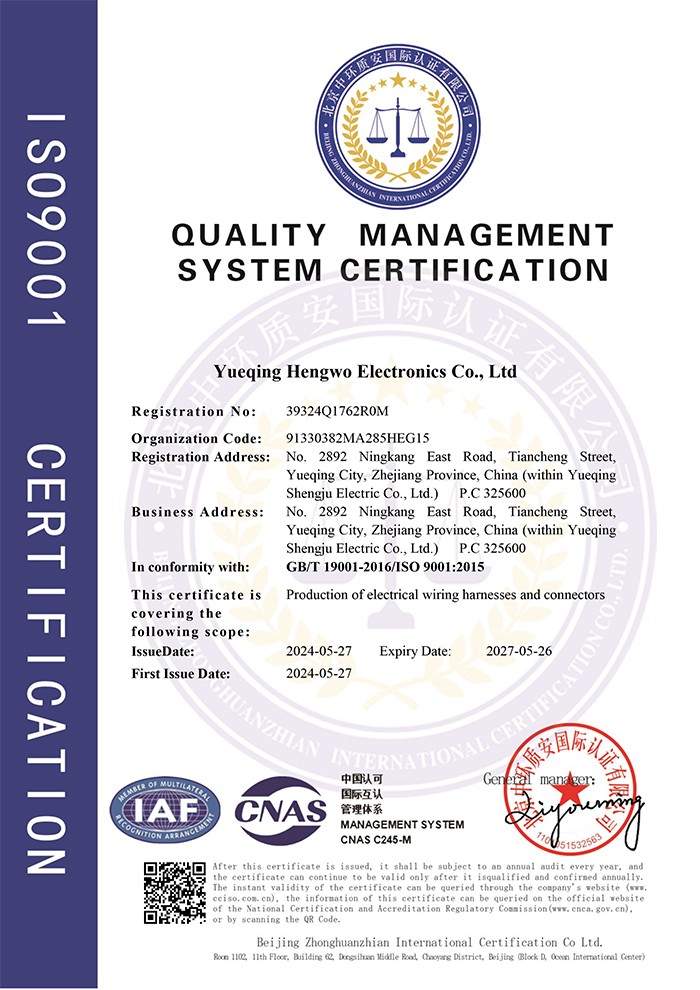
Zhejiang Hengwo Electronics Co., Ltd. is located at the southern foot of the national scenic area Beiyan Dang Mountain, east of the Yueqing Bay Deepwater Port, south of the Yongtaiwen Expressway, and 60 kilometers southwest of Wenzhou Airport. The geographical location is very convenient. It is a professional China Connector Head manufacturer and wholesale Connector Head factory. The products are widely used in LED display screens, lighting, machine tool equipment, communication electrical, mechanical electronics, magnetic relays, transformer meters, new energy batteries, automotive wiring harnesses, home appliances and other industries.
The company has strong technical strength and has a professional team with middle and senior professional titles integrating "development, design, and manufacturing". It has independent product design and development technology and a complete management system. It can develop various types of connectors according to the special requirements of customers and can meet the different needs of customers in all aspects. The products are deeply recognized and trusted by customers, especially in the household appliance connector industry. It has a high reputation.
The company specializes in the production of various models of bar connector series, needle seat terminals, wiring harness series, relay hardware plastics and other products. All employees of Zhejiang Hengwo Electronics Co., Ltd. adhere to the purpose of "integrity, pragmatism, refinement and innovation", always take "pragmatic innovation, quality first, customer satisfaction" as the business philosophy, and become a leader in the industry with reliable product quality and excellent service, and make unremitting efforts to become famous throughout the country.
In modern manufacturing, producing consistent, durable, and precise metal parts is essential. Hardw...
READ MOREAn Energy Storage Harness is a specialized assembly used to connect and manage energy storage devic...
READ MOREA Lithium Battery Wiring Harness is an assembly of cables, connectors, and protective components de...
READ MOREAn Automotive Wiring Harness Factory plays a crucial role in the automotive industry by supplying wi...
READ MOREA Hardware Stamping Factory plays a crucial role in modern manufacturing by providing precise metal ...
READ MOREWhy Are Connectors So Important in Wire Harness Systems?
In any modern electrical system, stable transmission depends heavily on interface components. A Connector Head allows wires to link with devices, control modules, or other harness branches in a stable and maintainable way. In industrial equipment, automotive platforms, and consumer electronics, its presence ensures that the harness can be serviced or replaced without disturbing the entire circuit.
Manufacturers emphasize dimensional accuracy, contact quality, and mechanical durability. Whether applied in automation or lightweight electronics, the Connector Head remains a critical part that supports both electrical continuity and assembly efficiency.
A Connector Plug functions as the active mating end of a harness. When inserted into its counterpart, it provides a conductive path that withstands vibration, repeated handling, and environmental exposure.
In the automotive sector, mounting zones may experience heat, dust, and movement. A well-designed Connector Plug ensures the harness remains stable even under mechanical load. In industrial machinery, its locking structure and housing materials help reduce accidental disengagement.
Below is a simplified view of what engineers evaluate during component selection:
|
Evaluation Dimension |
Considerations |
|
Electrical |
Contact resistance, current load, insulation |
|
Mechanical |
Locking strength, pull force, mating cycles |
|
Environmental |
Temperature limits, moisture protection, chemical exposure |
A Wire Connector is often chosen for zones that require frequent inspection or flexible routing. Because it improves modularity, technicians can remove or replace a sub-harness quickly during maintenance. In battery assemblies, lighting systems, and communication modules, the Wire Connector enhances both production efficiency and clarity of wiring layout.
Its role also extends to error-proofing. Different shapes or keying structures help prevent incorrect mating during assembly. This concept supports smoother workflow on production lines and minimizes rework.
1. Space Management
The geometry of a Connector Head affects how a harness is routed. When designers work with limited cavities—such as inside dashboards or compact machinery—they must balance size with required electrical performance.
2. Assembly Procedures
The locking format of a Connector Plug can determine the complexity of an installation process. If a component provides easier handling, it shortens the time required for technicians when connecting large harness bundles.
3. Modularity and Upgrades
Using a Wire Connector allows system modules to be updated without redesigning the entire layout. This approach is common in consumer electronics where models evolve quickly.
What Quality Indicators Should Buyers Pay Attention To?
With growing demand for compact devices and higher current density, engineers are designing tighter layouts and stronger insulation structures. The evolution of the Connector Head, the adaptability of the Connector Plug, and the precision of the Wire Connector will continue shaping how harnesses are built for electric vehicles, automation equipment, and smart appliances.
 No. 2892, Ningkang East Road, Tiancheng Industrial Zone, Yueqing City, Wenzhou City, Zhejiang Province, China
 +86-577-62315298
 +86-577-62312718
 hiwotek@163.com
